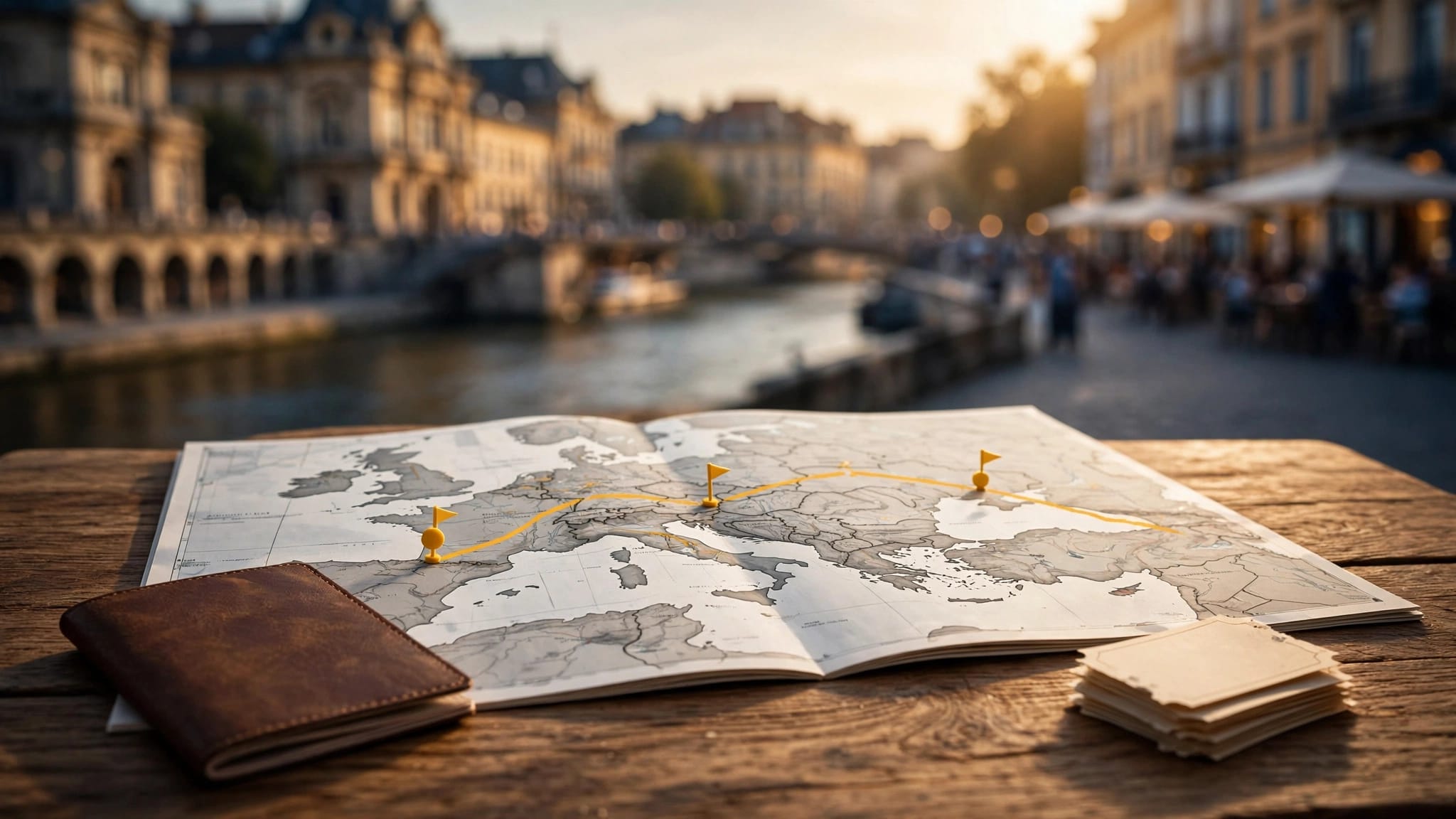
A great Europe trip shouldn’t feel like a race against your own itinerary. It should move in one clear direction, with three distinct cities, sensible connections, and room for unplanned discoveries.
The best three city Europe trip begins with open-jaw flights and cities that connect naturally. Sequence each stop around manageable rail or air transfers, then choose hotels near the neighborhoods and live experiences you want most. Schedules, fares, hotel availability, and entry requirements can change, so verify them before making nonrefundable bookings.
Start with the route, then let the food, neighborhoods, and live experiences give it a pulse. Leave enough time for each stop to feel like a chapter, not a box to check.
Key Takeaways
- Build the route in one geographic direction, using an open-jaw flight to reduce backtracking and protect valuable travel time.
- Choose three cities that connect naturally by direct rail or simple flights, then compare total door-to-door time before booking.
- Plan for 10 to 14 nights when possible, with roughly three to four nights per city and lighter schedules on transfer days.
- Book hotels near the neighborhoods, restaurants, venues, and experiences you care about so evenings stay easy and flexible.
- Confirm current fares, timetables, reservation rules, baggage policies, and entry requirements before making nonrefundable bookings.
Start With One Direction, Not Three Wish Lists
Europe is compact on a globe and deceptively large in real life. Prague, Amsterdam, Florence, and Paris can all look close enough on a map. They aren’t close enough when each move means checkout, luggage storage, a station run, and finding your way into a new hotel.
Choose an arrival city and a different departure city that follow one geographic line. Test each intercity connection before buying flights. Flying into Prague and out of Budapest can work. Flying into Rome and out of Venice can work. Arriving in Paris and departing Amsterdam can work, depending on the connections.
What doesn’t work is flying into Paris, jumping to Rome, then swinging back north to Amsterdam because each city sounded too good to leave out.
Every hotel change takes more than a train ride. It takes a morning, a little energy, and the easy rhythm you were starting to find.
Use an Open-Jaw Flight
An open-jaw ticket means you arrive in one city and fly home from another. It is often the cleanest choice for a route that keeps moving forward.
Compare the open-jaw fare with a round trip only after choosing your first and final cities. Check baggage rules, airport locations, connection risks, and change or cancellation conditions before you book.
The fare isn’t always lower than a round trip. Check the cost and time of reaching each airport, too. The benefit is often a saved transfer day, hotel night, or return journey, not a guaranteed lower fare.
Search flights after you’ve chosen your first and last city. Check the airline’s current timetable and baggage policy. Confirm the arrival and departure airports, and leave enough time between your final hotel night and flight home. Don’t force the route around the cheapest flight you found before you knew where you wanted to go.
Think Like You Are Building a Setlist
A good trip has pacing. You open with energy, change the tempo, give people room to breathe, then finish strong.
Put the city requiring the greatest adjustment at the beginning. Save your most romantic hotel, most anticipated concert, or best food city for the last stop. Avoid ending with a pre-dawn airport transfer.
Choose Cities That Actually Connect
The strongest trio combines geographic continuity with contrast. Each city should offer a different experience without making the travel pace feel rushed.
One route might mix architecture, history, cafes, and relaxation. A food-first canal district, grand museums, and a lively nightlife scene can work just as well.
Here are four combinations that keep the routing clean, though they’re starting points rather than rules.
Rail times below are approximate typical times for direct services, not guarantees. Check the current operator timetable, service frequency, engineering works, and reservation requirements for your dates. The listed duration excludes hotel checkout, the trip to the station, boarding, arrival, and the onward journey to your hotel.
| Route | Best for | Approximate typical direct rail time | Ideal trip length |
|---|---|---|---|
| Prague, Vienna, Budapest | Architecture, cafes, history, a medieval old town, thermal baths, nightlife | About 4 hours, then 2.5 hours | 10 to 14 days |
| Paris, Brussels, Amsterdam | Art, food, design, canals | About 1.5 hours, then 2 hours | 9 to 12 days |
| Rome, Florence, Venice | Food, art, Italian rail travel | About 1.5 hours, then 2 hours | 9 to 12 days |
| Munich, Innsbruck, Zurich | Alpine scenery, beer halls, mountain rail | About 2 hours, then 3.5 hours | 10 to 14 days |
The first three routes are especially approachable for a first-time multi-country trip. They’re compact, connected by frequent trains, and full of places where an afternoon can turn into a proper night.
The Munich, Innsbruck, and Zurich route deserves extra flexibility. Mountain weather and seasonal schedules can affect connections, so build in some room around those transfers.

Photo by Lara Jameson
The Best Three City Europe Trip Routes
The cleanest routes are the ones that let the cities feel different without making you pay for that difference in airports.
Prague Vienna Budapest
Prague, Vienna, Budapest is the classic Central Europe run for good reason. The cities line up naturally, and each one has a different personality.
Prague is atmospheric, compact, and made for long walks that end in a beer hall or wine bar. Vienna brings grand boulevards, coffeehouse culture, serious museums, and a more composed pace. Budapest is the late-night closer, with thermal baths, ruin bars, and Danube views that hit harder after dark. Leave one morning or evening open for the thermal baths instead of treating them as a quick add-on.
Direct Prague to Vienna trains often take around four hours. Vienna to Budapest usually takes about two and a half hours, but both estimates vary by date and service. Before booking, check the current direct service timetable, seat reservations, station details, and luggage arrangements. That is a real travel day, but not a day lost to security lines and airport transfers.
For women looking for a hosted version of this route, Sisterhood Travels’ Prague, Vienna, and Budapest tour shows why this trio works so well as a shared experience.
Paris, Brussels, and Amsterdam
This route works for travelers who want variety without long distances. Paris gives you museum days, intimate wine bars, and dinners that should never be rushed. Brussels can be a shorter, food-heavy middle chapter when your total nights and transfer time support it. Amsterdam finishes with canals, brown cafes, great design, and nights that can stay loose.
Paris to Brussels is roughly 90 minutes on the fastest services. Brussels to Amsterdam often lands around two hours. Once your dates are firm, book through the official Eurostar site. Check the departure station, baggage rules, seat or fare conditions, and weekend or holiday availability.
Paris can get overplanned fast. Stay near the version of the city you want to feel after dinner. Canal Saint-Martin works better than a generic central hotel if the trip tilts local, creative, and food-first.
Rome, Florence, and Venice
Italy’s rail network makes this one unusually easy. Rome has scale, noise, ancient ruins, and long dinners. Florence is smaller, more art-focused, and ideal for slowing down. Venice is best as the final stop because there is nothing else that quite feels like it.
The mistake is treating Florence as a quick box to check between Rome and Venice. Confirm museum reservations, train schedules, hotel check-in windows, and luggage storage together. Then give Florence enough time for an early coffee, one museum visit, a long lunch, and an evening away from the busiest streets.
Give Each Stop Enough Time to Land
Three cities in seven days can be done. The route involves at least two major transfers, plus check-in and checkout friction, leaving little usable time in each city.
For most travelers, 10 to 14 nights is a useful planning range, not a fixed rule. That usually means three to four nights in each city, with room for travel days and one unplanned afternoon.
How Long to Spend in Prague
Three full days in Prague is a strong starting point. You can see Prague Castle and Charles Bridge without sprinting. Then spend time in the Jewish Quarter, cross the river toward Letna, and leave evenings for wine bars, live music, or a proper Czech meal.
A fourth night is worth it if you want a slower first day after an overnight flight. It also leaves room for day trips to Kutna Hora, or simply more time beyond your first pass.
Don’t try to “complete” Prague in 36 hours. It is a city built for wandering, not a collection of places to clear before lunch.
The Three-Night Rule
Three nights generally provide two full sightseeing days, plus a softer arrival or departure day. Four nights can absorb recovery from an overnight flight, a delayed train, laundry, or an unplanned afternoon.
Use four nights for Paris, Rome, Prague, or Budapest if they are your priority. Three nights works well for Vienna, Florence, Brussels, Amsterdam, Venice, and Zurich.
If your trip is built around a festival, football match, concert, or birthday dinner, add a night. Check the event dates before finalizing hotels. You don’t want your biggest evening competing with a 7 a.m. checkout.
Take the Train When It Protects the Day
For city pairs under about five hours by rail, I usually choose the train. That’s a planning rule, not a guarantee. Compare total door-to-door time, including hotel-to-station travel, before booking.
High-speed trains also give you a better transition. You can have breakfast in Vienna, watch the landscape open up, then check into Budapest with time for a bath before dinner.
When Rail Is the Better Call
Train travel wins when stations are central, departures are frequent, and services are direct or simple. Rome to Florence, Florence to Venice, Paris to Brussels, Prague to Vienna, and Vienna to Budapest are all made for it.
Check the current operator timetable before booking. Look for service disruptions, seat reservation rules, rail-pass restrictions, and luggage policies.
Keep in mind that fast services can require an extra paid seat reservation, even if you have a rail pass. Eurail’s high-speed train reservation guidance is worth reading before you assume your pass gets you onto every train.
Give yourself a 20 to 30-minute station buffer. That covers finding the platform, grabbing water, and boarding without turning the morning into a sprint. Build a larger transfer buffer when traveling from a hotel across the city or changing stations. Large luggage, children, mobility needs, or an unfamiliar station may require more time.
When a Flight Is Worth It
Fly when the train takes six hours or more, requires awkward changes, or crosses a body of water. These are planning heuristics, so compare total door-to-door time before choosing air. Include airport check-in, security, baggage drop, and ground-transfer time. Fares and schedules can change.
Book the earliest flight only if you are naturally an early mover. A 6 a.m. airport departure may look efficient. It can also wreck the previous night’s dinner, drinks, and sleep.
One good rule: if the city you are leaving deserves a final late night, don’t book the flight that punishes you for taking it.
Pick Hotels That Keep Your Evenings Intact
A cheap hotel far from dinner is rarely cheap after taxi or rideshare costs add up. Count the time spent getting home, too. Your hotel should make evenings easier, with reliable late-night connections nearby.
In Prague, Old Town and Mala Strana put first-time visitors near the postcard moments. Vinohrady is a stronger call for travelers who want local restaurants, wine bars, and a quieter return at night. Compare the nightly rate, not just the neighborhood’s reputation.
In Paris, Canal Saint-Martin gives you creative energy and strong food options. Saint-Germain-des-Pres works for classic Paris, polished stays, and easy Left Bank walks. Choose based on your evenings, your budget, and the route home.
Build Each Day by Neighborhood
Don’t ask public transit to save an itinerary that sprawls across town. Use trains, metro lines, and taxis for clean jumps. Build the rest on foot, around activities that share a neighborhood.
Before booking dinner or drinks, check the last train or metro. Estimate the walking time back with luggage, and confirm late-night service is reliable. Avoid reservations on opposite sides of the city.
A great city day has one anchor, one neighborhood cluster, one meal that matters, and a realistic route home. In Paris, that might mean a museum on the Left Bank, a walk through Saint-Germain, dinner nearby, then drinks without crossing the city again.
The same principle makes every stop better. You notice the bakeries, side streets, record shops, and bars that never appear in a rushed list of tourist attractions.
Put Your Big Reservations on the Calendar First
The best table in a small dining room does not care that you waited to decide. Neither does a sold-out concert, a major football match, or a timed museum entry.
Lock in the moments that cannot move. Then build the trip around them. My European rail trip food reservations guide shows how to time those tables against train schedules and station buffers.
Start With the Night
If music is your thing, check venue calendars before booking flights. Confirm the event date, start time, doors, ticket-transfer rules, and venue location.
Check whether the venue is exposed to the weather, and map the route back to your hotel. For international events, confirm that the ticket name matches your identification and check special entry requirements.
Build dinner, security, doors, weather, and the return journey around the show, not the other way around. Keep the radius tight and let the show be the center of the night, as this concert trip planning guide recommends.
Event calendars, ticket availability, and transport schedules can change. Verify them again shortly before departure.
Book dinner near the venue when possible. You will enjoy both more when the clock is not looming over the table.
Leave Space Around the Reservation
A confirmed dinner should replace a chain of distant bookings, not trigger one. Keep the morning easy, with time for luggage storage or a hotel reset on a transfer day. Plan one nearby bar for after-dinner drinks, not a forced crawl across town.
This is where premium travel feels different. The experience has range, but no one is checking maps every 15 minutes.
Budget for the Friction You Can Avoid
Your biggest Europe costs are often flights, hotels, long-distance transport, meals, and experiences. The most expensive line item isn’t always the one worth trimming. Pay more only when the expense protects usable time or a genuinely important experience.
A hotel in the right neighborhood can save on taxis and give you back two useful hours each day. A direct train can cost more than a cheap flight, but it may spare airport transfers, luggage hassles, and a lost afternoon. A good dinner reservation can become a lasting memory when it supports an experience you genuinely care about.
Rail Pass or Point-to-Point Tickets?
For a fixed three-city plan, point-to-point tickets are often the better value. Compare the base fare with seat-reservation fees, luggage costs, local station or airport transfers, and change restrictions.
Buy early when you know your dates, especially for Eurostar and Italy’s Frecciarossa or Italo trains. Advance fares may be cheaper, but they’re often less forgiving when plans change.
A Eurail pass is better when your plans are flexible or you expect to add several longer side trips. The current Eurail pass options cover 33 countries, but verify coverage and reservation rules for every train on your proposed route. A pass doesn’t guarantee a seat, and popular high-speed services may sell out or require additional reservations.
Price both options before you commit. Include the ticket or pass cost, reservation fees, luggage-related costs, local station or airport transfers, and change restrictions. Then weigh the value of flexibility, not just the lowest total.
Sort Documents Before You Buy the Nonrefundable Stuff
Non-EU travelers should check entry rules for their own passport, nationality, length of stay, and travel purpose. Use official government or EU sources, not a friend’s passport or an old blog post. Requirements may include a Schengen visa, passport-validity rules, proof of accommodation, onward travel, or travel insurance. Rules and appointment availability can change.
If you need a Schengen visa, start early. Appointment availability can be slow, especially before summer, and requirements may change.
ETIAS and the Entry/Exit System
For visa-exempt visitors, the EU’s official ETIAS travel authorization page says ETIAS isn’t currently operating and applications aren’t being collected. Check that same official source before departure and during trip preparation, since timing and requirements can change.
Check official guidance for the Entry/Exit System’s current status and traveler process before departure. Give yourself extra time at border control after a long-haul arrival or when moving between Schengen and non-Schengen countries.
Keep secure digital and printed copies of passports, visas or authorizations, rail and flight reservations, hotel confirmations, insurance details, and onward-travel evidence. It is basic operations, but it removes stress when Wi-Fi is weak or a phone battery decides to become part of the story.
Treat Transfer Days Like Half Days
A 10 a.m. departure does not mean you have a full afternoon waiting on the other side. Allow time for checkout, local transport to the station or airport, and a station or airport buffer. Then count boarding, security, journey time, arrival, luggage collection, and hotel drop-off or storage.
Plan one light activity after arrival, close to the new hotel. Walk the neighborhood, have an aperitivo, or take a canal tour if that is the city. Keep it flexible or cancellable when possible, and save the major museum or landmark for the next morning.
Carry a small train-day kit: water, snacks, charger, headphones, a light layer, medication, and anything you need before hotel check-in. Keep the bag light enough to manage platform access and overhead storage. Keep valuables with you, and verify platform information and service updates on the day of travel.
If you have large bags or mobility limitations, build in more than the minimum buffer.
Travel days are part of the trip. They don’t need to be dead space, but they can’t carry the weight of a full sightseeing schedule.
Frequently Asked Questions
What is the best length for a three-city Europe trip?
For most travelers, 10 to 14 nights gives each city enough time to feel substantial. Plan for roughly three to four nights per stop, including time for transfers and one unplanned afternoon.
Should I use an open-jaw flight for a three-city Europe trip?
Usually, yes, when your route moves in one direction. Flying into one city and home from another can eliminate a return journey, though you should compare the full fare, airport transfers, baggage rules, and change conditions with a round trip.
Is it better to travel by train or plane between European cities?
For city pairs under about five hours by rail, the train often protects more usable time because stations are usually central and airport procedures are avoided. Compare door-to-door time, service frequency, fares, luggage rules, and any required reservations before deciding.
How many nights should I spend in each city?
Three nights usually provide two full sightseeing days, while four nights allow more room for jet lag, delays, laundry, or an unplanned afternoon. Give an extra night to priority cities or destinations with a concert, festival, match, or major dinner reservation.
How can I avoid backtracking on a Europe itinerary?
Choose an arrival city and a different departure city that follow a clear geographic line, then test each intercity connection before booking flights. Keep transfer days light, stay near convenient stations or neighborhoods, and avoid adding a city simply because it looks close on a map.
Make the Route Feel Like Your Trip
The strongest route is not the one with the most stamps in a passport. It is the one where the geography makes sense, hotel locations protect your nights, and each city has enough room to become more than a backdrop.
Choose an arrival and departure city that reduce backtracking. Compare door-to-door rail and air time, then choose trains that preserve your day. Protect your evenings with well-located hotels, and keep transfer days intentionally light.
Build in one direction. Give your best meals, live music, and unscripted neighborhood time the space they deserve.
Recheck fares, timetables, reservations, and entry requirements before departure. Keep the plan flexible enough for moments you can’t schedule.
Flow beats volume. You will remember the bar you found after dinner, the last train across the Danube, and the street you wandered because the itinerary left room for it.