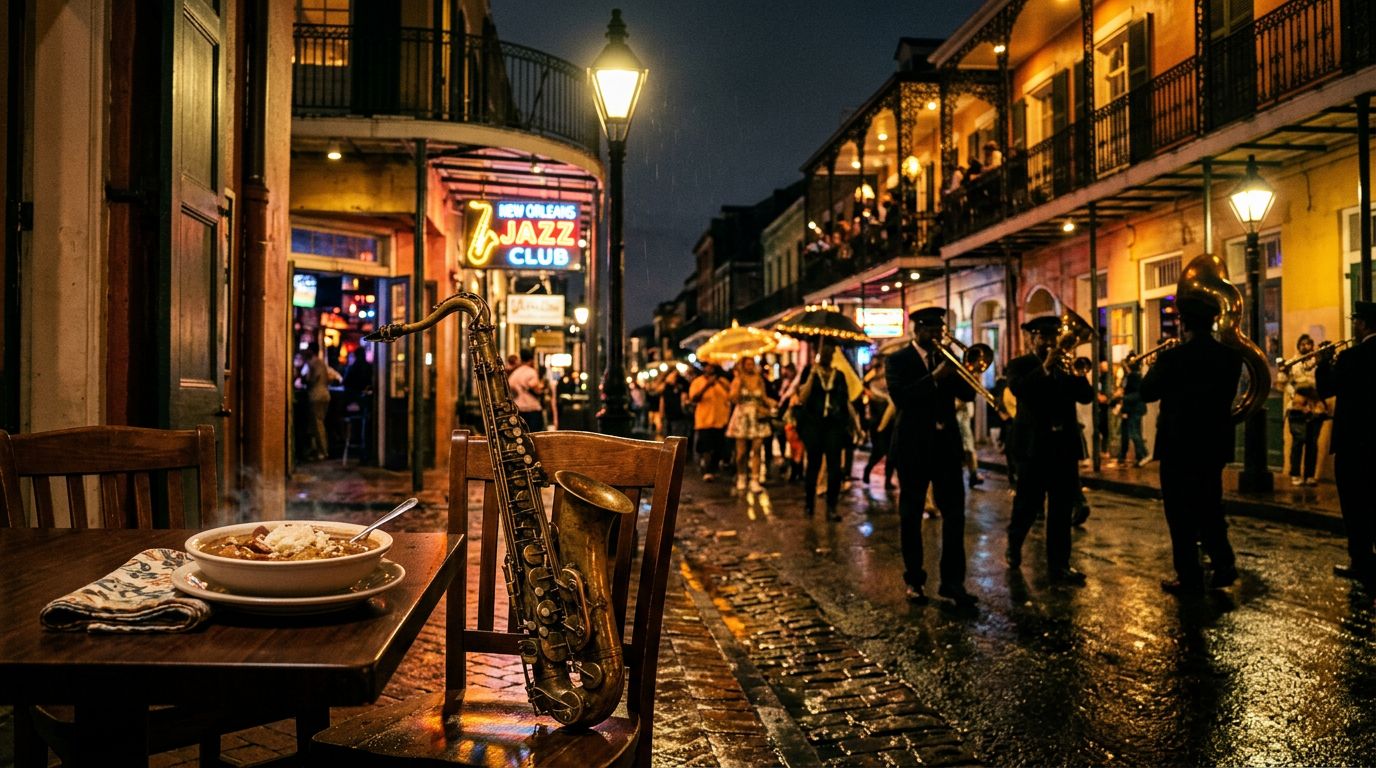
New Orleans can give you a perfect night, then ruin it with one bad cross-town plan. A dinner reservation in the Garden District, a set at one of the top New Orleans jazz clubs, and a hotel near Canal Street may look close on a map. They are not close once rain starts, the streets fill up, and the band you wanted to hear goes on at 10.
The city works when you let one neighborhood lead the night. Because this is the birthplace of jazz, the music and food scenes are not interchangeable. A bar featuring local brass bands, a serious Creole dining room, a late po-boy, and a second-line parade all ask for a different kind of plan. When you embrace the pace of the Big Easy, you find that the best experiences happen when you build your days by area, book the meals that matter, and leave enough room for one more song.
Key Takeaways
- Frenchmen Street in the Faubourg Marigny neighborhood is the easiest place to build a music-first night without fighting the crowds.
- The French Quarter works well for historic jazz and classic Creole rooms, but it requires a tighter filter to find the best spots.
- Tremé gives you the strongest sense of New Orleans history, especially when food and culture matter as much as nightlife.
- Uptown is the move for bigger venues, polished dinners, and a night that can run long without feeling touristy.
- Keep dinner close to the music. New Orleans rewards appetite, timing, and a little patience.
Read the City by Night, Not by Landmark
New Orleans is a city of neighborhoods with distinct personalities that define the Big Easy. The French Quarter is dense, loud, historic, and easy to enter. Marigny feels looser and more music-led. Uptown has porch light, old oaks, and rooms where dinner can become the whole evening. Tremé carries history in a way that does not need much production.
The biggest mistake is trying to collect every famous name in one weekend. You do not need Preservation Hall, Frenchmen Street, Tipitina’s, a swamp tour, a Jazz Museum visit, and a Commander’s Palace dinner all in 36 hours. That is not range. That is bad sequencing.
Think of each day like a setlist. Start with an opening that fits the neighborhood, find a spot for great live music to serve as your centerpiece, and end near your hotel or somewhere worth staying out for.
One great meal, one real music room, and one walk home through the right neighborhood will beat five rushed reservations every time.
For most first visits, stay in the French Quarter, Marigny, CBD, or Lower Garden District. Those bases keep late-night rides manageable and give you options when a reservation runs long. A cheaper hotel near the airport or far west of Uptown tends to stop feeling cheap once you start paying for rides back.
New Orleans is walkable in pockets. It is not a city where walking across the full map is always smart. Use streetcars for the experience and short daytime jumps. Use rideshare after dark, especially during heavy rain, summer heat, or after a late show when your feet are done.
Check the WWOZ Livewire music calendar before building your nights. The city changes fast. A room that is quiet on Tuesday can have the best local bill of your trip on Thursday.
Marigny and Frenchmen Street for Live Jazz Without the Script
If music is the reason for the trip, begin your journey in Faubourg Marigny. Frenchmen Street is the most accessible entry point into New Orleans live music because the venues are packed close together, giving the night a natural momentum. You can hear a full brass band set, stop for a drink, catch a talented pianist, and then walk ten minutes on foot instead of spending your night in a car.
Start with dinner before the clubs fill up. Paladar 511 is a strong reservation when you want pasta, seafood, and a more composed start than standard bar food. The menu changes, the room is intimate, and the pace feels right for a night that still has plenty of places to go.
After dinner, Frenchmen Street gives you endless choices without forcing you to follow a rigid checklist.
Snug Harbor Jazz Bistro is the move when you want a seated show and serious musicianship. It feels more like a dedicated concert room than a bar where music happens in the corner, offering a perfect setting for modern jazz. Buy tickets early if there is a specific artist you care about.
The Spotted Cat Music Club is smaller, louder, and more casual. You stand close, and you can really hear the horn section push through the room. If you want the version of New Orleans that looks like a great night before it gets too messy, this is it. You might even catch groups like Tuba Skinny playing their signature brand of traditional jazz.
d.b.a. has a larger room and a broader booking style. One night may bring brass, another jazz, or a performance that leans toward funk and soul. Maison is useful when you want multiple stages and do not feel like committing to one set.
Do not turn your visit into a speed run. Pick one venue as your anchor, then let the next stop be a decision you make after hearing the first band. The best nights in this neighborhood often happen because local musicians are playing at their best and nobody wants to check the time.
For a late bite, grab something simple nearby or head toward the Quarter if your group still has energy. Keep it loose, as a big formal dinner after midnight is rarely the right move.
The French Quarter for Old Rooms and Creole Classics
The French Quarter is not fake. It is simply crowded with people trying to sell you a version of New Orleans that can feel thinner than the real thing. You have to edit hard.
Start early. Walk Royal Street before the afternoon crowds arrive, cut through Jackson Square, and give yourself time around the river. The French Quarter lands best before you are shoulder-to-shoulder with a bachelor party carrying a frozen drink the size of a lamp.
For an old-school Creole meal, Arnaud’s still works when you want history, tuxedoed service, soufflé potatoes, and a room that understands occasion. Galatoire’s has its own loyal following, especially for a long Friday lunch, although the energy can be more social than intimate.
Antoine’s is the oldest name in the group and makes sense if the history is the point. Go knowing that you are choosing a New Orleans institution, not chasing the city’s most modern meal. That distinction matters.
Preservation Hall should be treated differently from a bar. The sets are short, the room is small, and the music is the entire point. You are not there to talk through a cocktail. You are there to hear authentic New Orleans jazz in a stripped-back room that has kept the format simple for decades.
Fritzel’s European Jazz Pub is another solid option for traditional jazz. It is more casual than Preservation Hall and easier to work into a flexible night. If you prefer a more polished atmosphere, consider The Jazz Playhouse inside the Royal Sonesta New Orleans, which offers a refined setting to enjoy live music.
Bourbon Street is worth seeing once. Walk it, take in the volume, then leave before it becomes the whole trip. The French Quarter has better corners. A Sazerac at The Sazerac Bar inside The Roosevelt is a polished reset if you want old New Orleans glamour without the chaos outside.
Keep your dinner and music inside the district on this night. The distance is short, the streets stay active, and you won’t lose the evening to traffic.
Tremé for Food, History, and the City’s Real Roots
Tremé is where your trip becomes truly meaningful. As one of the oldest Black neighborhoods in the United States, its relationship to local music is essential rather than decorative. Vibrant brass bands, social aid and pleasure clubs, Mardi Gras Indian traditions, gospel, and the deep roots of jazz culture all trace their origins back to this historic part of the city.
Start your exploration around Louis Armstrong Park and Congo Square. Often considered the spiritual birthplace of jazz, the area is best experienced by walking slowly. Take the time to read the markers and notice how the atmosphere shifts the moment you cross North Rampart Street, leaving the tourist bustle of the French Quarter behind for a more authentic neighborhood feel.
For lunch, Dooky Chase’s Restaurant belongs high on your list. The late Leah Chase built something far bigger than a famous dining room. The restaurant became a historic gathering place for civil rights leaders, local artists, and generations of New Orleanians. While the fried chicken is iconic, the gumbo, red beans, and various Creole classics are the real reasons to linger at the table.
Lil Dizzy’s Cafe is another excellent Tremé option if you are craving authentic Creole soul food. Go hungry, as the portions are generous and do not require any strategic appetizer planning.
The New Orleans Jazz Museum is not located in Tremé, so do not feel pressured to force it into your itinerary just because the name fits. Keep this part of the city focused on neighborhood history, authentic food, and the music that still echoes through these streets, including the brass bands that define the local sound.
Kermit Ruffins’ Mother-in-Law Lounge sits nearby in the Seventh Ward and is worth watching for show nights. It is not a place to visit blindly. Check the calendar, confirm the performance details, and go when the room has a reason to be full.
Tremé rewards respect. Do not treat it like a simple photo stop between brunch and Bourbon Street. Eat somewhere with history, listen when there is music, and if you happen to encounter a second line, give the participants space and follow the local cues.
Uptown for Big Shows, Long Dinners, and a Better Pace
Uptown is where New Orleans feels more residential, more relaxed, and a little more polished. The streets are wider, the houses have porches, and the oak trees do half the visual work. It is also one of the best areas for travelers who want a real dinner before heading out for the evening.
Start in the Garden District or Lower Garden District, then move up Magazine Street. You can spend an afternoon browsing shops, stopping for coffee, and avoiding the urge to put another museum on the schedule.
Commander’s Palace is the obvious Creole splurge. The blue building is iconic, but the experience works because the service stays warm and the food still has character. This is a place for a reservation, a jacket if that suits your style, and enough time to enjoy the meal.
For a more intimate dinner, Brigtsen’s in Riverbend is one of the stronger choices in the city. Frank Brigtsen’s cooking is rooted in Louisiana tradition without feeling trapped by it. The menu is built around seafood, local ingredients, and the kind of sauces that make you slow down.
Then choose the room that fits your night. Tipitina’s is a New Orleans institution and the right call for funk, brass, touring acts, and shows that feel bigger than a bar set. As a premier music venue, it consistently draws big crowds. The Maple Leaf Bar is another legendary music venue that remains more casual and often more local in spirit. It has hosted music for decades, and its late-night rhythm is hard to fake.
Le Bon Temps Roule is another smart Uptown move when you want live music without a heavy production. The room is rough around the edges in the right way. Get a drink, find a place near the stage, and don’t expect anyone to rush the night along. Whether you are looking for local legends or traveling talent, the area is perfect for enjoying live performances until the early hours.
The St. Charles streetcar is worth riding during the day. After a late show, call the car. That is not laziness; it is good planning.
Mid-City and Bywater When You Want Less Polish
Mid-City works well for travelers who want food, local bars, and a break from the constant motion of the French Quarter. It is also a useful base around Jazz Fest, since the Fair Grounds sit nearby. During festival weekends, book restaurants and rides early, as the city gets busy fast.
Neyow’s Creole Cafe is a classic Mid-City choice for chargrilled oysters, fried seafood, gumbo, and Creole comfort food. It is popular for a reason. Go at an off-hour if you hate waiting, or accept the line and settle in.
Parkway Bakery & Tavern is the po-boy stop when you want something casual and distinctly New Orleans. The roast beef po-boy is the move for many regulars. It is messy, rich, and not meant for a quick bite in the back of a rideshare.
For music, Chickie Wah Wah has a listening room feel and a local booking calendar that often rewards people who look beyond the biggest names. It is a good place to catch live music, including singer-songwriters, roots music, and New Orleans artists that you might not find in the standard rotation on Frenchmen Street.
Bywater is rougher, more colorful, and better when you want the night to feel less curated. Start with dinner at The Country Club if you want a leafy courtyard and an easy, social atmosphere. Bacchanal Fine Wine & Spirits is another reliable choice for wine, cheese, small plates, and courtyard music.
Vaughan’s Lounge is the bar to watch if you want a neighborhood room with real New Orleans character. Kermit Ruffins has long been connected to Thursday nights there, though schedules can change. Confirm before you plan your entire evening around it.
BJ’s Lounge is another Bywater name worth knowing for local energy and brass bands that capture the authentic spirit of the city. This isn’t the place for a polished, early bedtime. It is the place for a night that gets better after your original plan ends.
How to Order Creole Food Without Eating the Same Meal Twice
Creole food is not one dish, and New Orleans menus can blur the lines between Creole, Cajun, soul food, seafood house staples, and Italian influence. The city has room for all of it. You do not need to become a food historian before dinner. You just need to order with some range to truly experience the depth of local flavors.
A good Creole meal often moves through seafood, tomatoes, butter, roux, herbs, rice, and the holy trinity of onion, celery, and bell pepper. Gumbo is the obvious starting point, but do not assume every bowl tastes the same. Some are darker and smokier, while others lean more heavily on seafood or okra.
Build your meals around different textures and formats:
- Start one lunch with gumbo and a po-boy, then save the heavier Creole platter for another day.
- Order barbecue shrimp at a restaurant that knows the dish, and have bread ready for the sauce.
- Try turtle soup, shrimp remoulade, or oysters Rockefeller when you want the older French-Creole side of the city.
- Make room for red beans and rice, fried chicken, or smothered pork chops at a soul food spot.
- End one afternoon with pralines or a sno-ball instead of another cocktail.

Photo by SONIC
Crawfish boils are part of the Louisiana food story, but they are more closely tied to Cajun country than classic Creole restaurant cooking. That does not mean you should skip them. It just means you should not call every Louisiana dish Creole simply because it has spice in it.
The same rule applies to your drink selection. Have a Sazerac where the room suits it, or explore other classic cocktails that pair perfectly with the rich profiles of your meal. If the heat calls for it, a frozen drink is always an option, but try not to let sugary beverages dull your appetite before the food arrives. New Orleans has too many legendary plates for you to fill up on anything less than the main event.
Build a Weekend That Leaves Room for the Good Stuff
A strong three-night trip can stay simple.
Make your first night in the Marigny. Eat nearby, hear one or two sets at the best New Orleans jazz clubs on Frenchmen Street, and let the city introduce itself through music. Use the second day for exploring Tremé or the French Quarter, depending on whether local history or old-school Creole dining matters more to you. Keep your evening plans in the same zone to avoid unnecessary travel.
Save Uptown for the night you want to dress up, eat well, and catch a bigger show. If your trip runs longer, add Mid-City or Bywater to experience the less polished side of town.
Reservations matter most for Commander’s Palace, Brigtsen’s, Dooky Chase’s, and any room with a specific artist you want to see. Don’t overbook every meal. Leave one lunch open for a place with a short line and one late-night slot to follow the sound of distant brass bands spilling out through an open door.
Summer requires a slower pace. The heat can make a packed afternoon feel exhausting by 2 p.m. Plan a long lunch and hotel downtime, then emerge once the sun dips for dinner and live music. During Mardi Gras, Jazz Fest, French Quarter Fest, and major Saints weekends, your plan needs more margin. Hotels, tables, and cars disappear quickly.
The city doesn’t reward efficiency for its own sake. It rewards a plan that protects the spontaneous, soulful moments you came for.
Frequently Asked Questions
Do I need to buy tickets in advance for jazz clubs?
For most venues, you can simply walk in and pay a cover charge at the door. However, if you have your heart set on a specific headliner at a place like Snug Harbor or a major show at Tipitina’s, it is always worth checking the venue website to book your spot ahead of time.
Should I try to see every famous jazz spot in one trip?
Avoid the temptation to chase every landmark on a map, as this leads to a rushed and stressful experience. It is much better to anchor your night in one neighborhood, pick a single venue to start, and let the rest of your evening flow naturally from there.
Is it safe to walk between music venues at night?
New Orleans is a city of neighborhoods, so walking is perfectly fine when you are staying within a concentrated area like Frenchmen Street. However, if you are traveling between districts late at night or during inclement weather, stick to rideshare services to keep your transit times manageable.
What is the best way to find out which bands are playing?
The music scene in New Orleans moves fast, and schedules can change on short notice. Always check the WWOZ Livewire music calendar before heading out to ensure you catch the performers you are most interested in seeing.
The Right New Orleans Night Has a Rhythm
New Orleans is at its best when the food and music belong to the same night. Enjoy a bowl of gumbo before catching a local brass band in action. Plan a polished Creole dinner before heading to Tipitina’s, or grab a late po-boy after a performance on Frenchmen Street that went longer than expected.
Pick your neighborhood first and let one quality meal and one venue carry the evening. The city has a way of meeting you where you are, whether you are seeking the soulful energy of iconic New Orleans jazz clubs or the spontaneous, horn-heavy sets found throughout Frenchmen Street. Let the rhythm of the city guide your plans and the rest will fall into place.