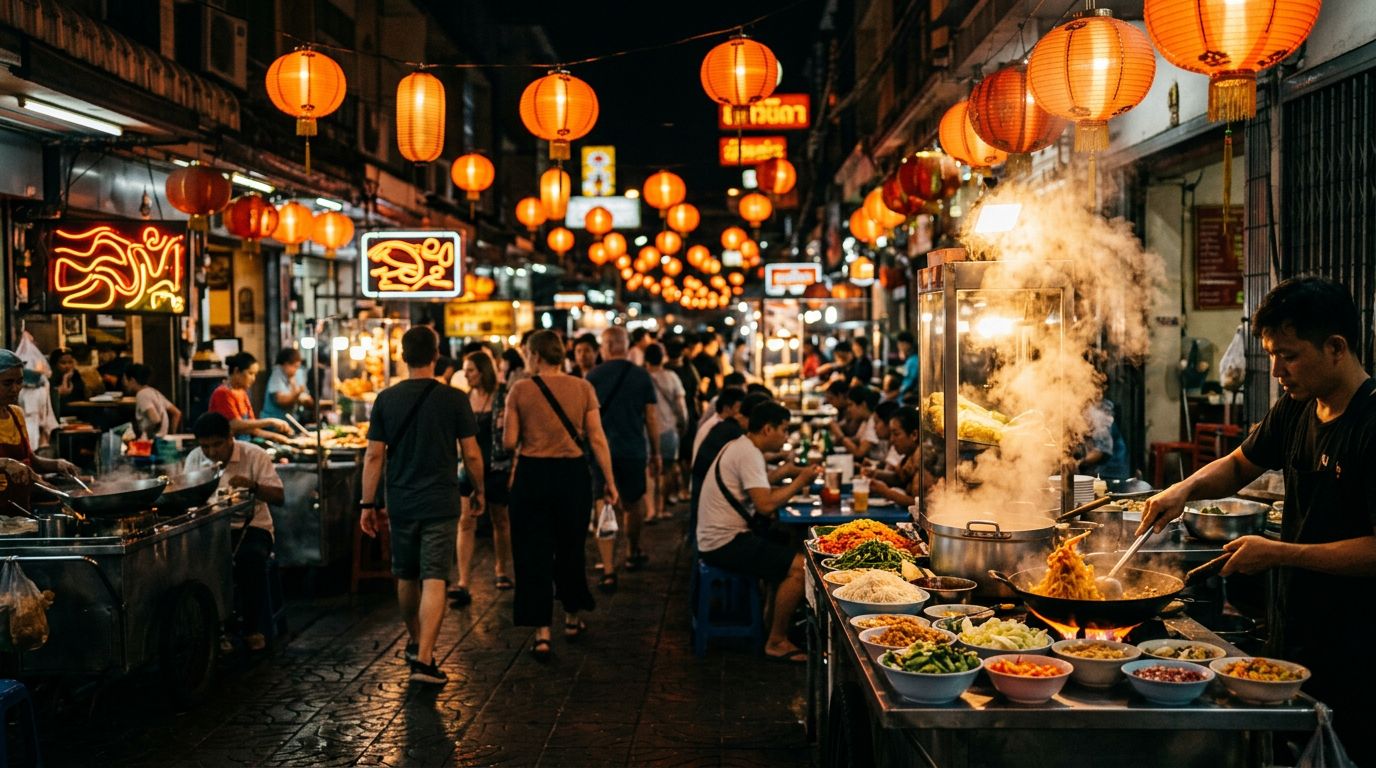
Bangkok is the kind of city where dinner at 8 can turn into noodles at midnight and one last dessert at 1 a.m. The hard part isn’t finding food. It is choosing the right Bangkok street food neighborhoods to ensure your late-night eating adventure is a success. Whether you are craving spicy tom yum or sweet mango sticky rice, there is no shortage of incredible Bangkok street food.
Most first trips get tripped up by geography. The city is huge, traffic is real, and one bad cross-town move can flatten the evening. I have found Bangkok is far better when you build around one food district, walk it properly, and use transit only for the jump that makes sense.
Key Takeaways
- Yaowarat Chinatown is still the strongest all-around move for first-timers who want classic Bangkok late-night food energy.
- The Bang Rak neighborhood, Silom, and Banthat Thong work best when you want great eating without giving up a polished night out.
- Talat Phlu and Wang Lang feel more local and more relaxed, and they are worth the extra effort for those seeking an authentic culinary experience.
- Every night market offers a different vibe, so pick them for atmosphere, browsing, and variety rather than just following a map.
- Walking shows you the texture of the city. Use a nearby BTS skytrain station for clean jumps between neighborhoods, then take a taxi or Grab home late after exploring your chosen night market.
How To Read Bangkok’s Food Map
The best Bangkok street food neighborhoods are not interchangeable. Some areas are built for smoky midnight seafood, while others offer a different experience entirely. Choosing the right spot for your Bangkok street food adventure depends on whether you want after-work dining, a dedicated dessert crawl, or a vibrant bar scene. Some locations look exciting online but work better as a quick stop than a full night.
Bangkok also punishes bad geography. A late reservation across town can look harmless on a map, then cost you an hour in traffic and most of your patience. The fix is simple. Keep the night tight. Focus on one district, one main eating lane, and one backup plan. This helps you easily navigate the dense concentration of street food stalls and connect with the best local food vendors in the area.
This quick comparison keeps the trade-offs honest:
| Area | Best for | What the night feels like | Usual sweet spot |
|---|---|---|---|
| Yaowarat | First-timers, classic street food | Dense, loud, smoky, electric | 6 p.m. to midnight, often later |
| Bang Rak and Silom | Central stays, dinner into drinks | Easy, mixed, more polished | 6 p.m. to midnight |
| Banthat Thong and Sam Yan | Sam yan market, authentic thai food | Young, busy, line-heavy | 7 p.m. to late |
| Talat Phlu | Local food focus | Older-school, less performative | Evening through late night |
| Wang Lang | River day plus casual evening eats | Lively, local, less touristy | Late afternoon to night |
Most food areas in Bangkok find their groove between about 6 p.m. and 10 p.m. That is when the stalls are firing, the sidewalks are full, and the neighborhood feels awake without being too cooked. If you want a wider map before you land, this roundup of Bangkok street food sanctuaries is a useful skim.
Pick one neighborhood for the night, not three.
That sounds obvious, but it changes everything. Bangkok gets good at street speed. You notice the charcoal smoke, the fruit carts, the one stall with a line of locals, and the side street that suddenly looks better than the main drag.
Yaowarat Chinatown Is The Classic For A Reason
If you want the neon, the smoke, the wok heat, the seafood, and the whole experience, go to Yaowarat. Bangkok’s Chinatown is still the top overall choice for late-night eats, and in 2026, Yaowarat Chinatown remains the city’s most reliable high-energy food district. For those looking to map out their evening, checking a Michelin street food guide is a smart way to pinpoint the best street food stalls hidden along the busy thoroughfare. The core stretch around Yaowarat Road works best from early evening through midnight, though parts of the area keep rolling much later.
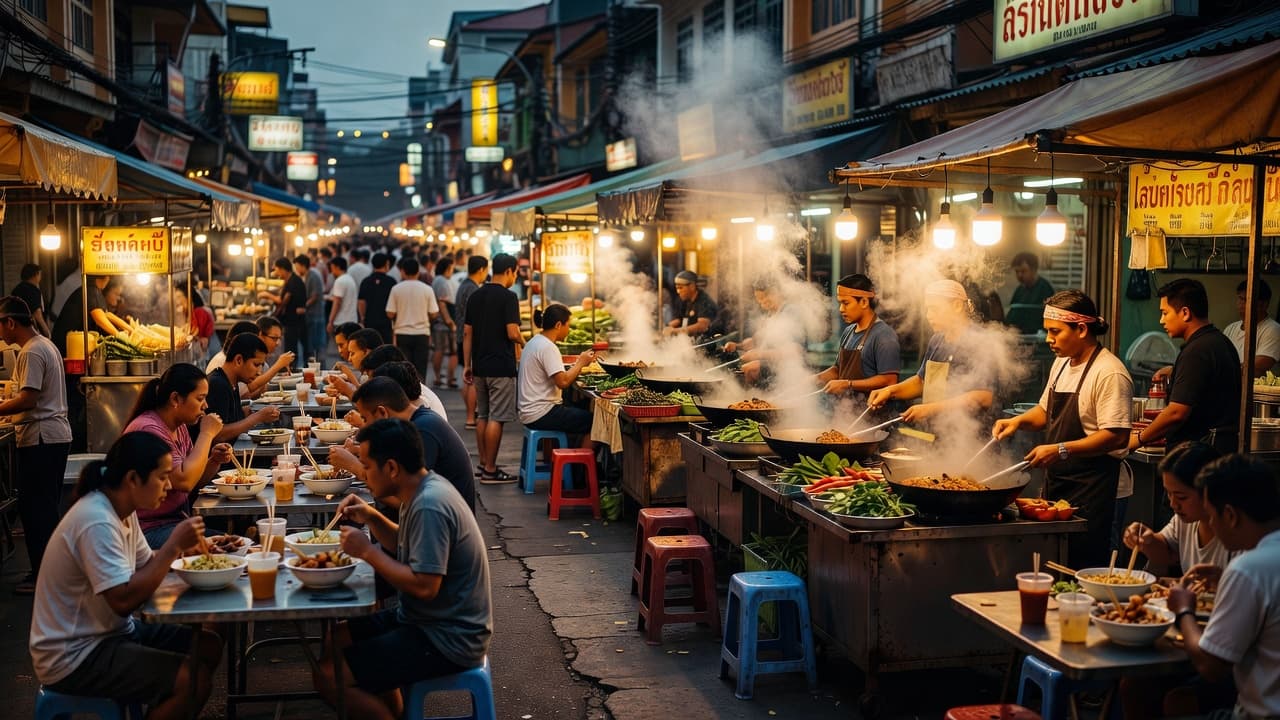
What makes this area land isn’t only the volume of food. It’s the density. You can move from grilled prawns or a classic pad thai to oyster omelets and steaming bowls of tom yum goong without ever losing momentum. Arriving at the local MRT station is the clean move, and once you’re there, keep walking. The side streets often reward you more than the brightest section of the main road.
This is not the night for over-scheduling. Don’t stack a rooftop drink in one district, dinner in Chinatown, then a bar somewhere else unless you truly want the admin. Yaowarat is enough. Eat once. Walk. Eat again. If the first stool you grab ends up being average, keep moving. A better plate is usually thirty steps away.
The area also works across budgets. You can keep it fully street-side, or you can mix in a more comfortable sit-down meal without losing the feel of the neighborhood. That balance is why it works for first visits, group trips, and food-first travelers who want Bangkok to hit hard right away.
If you want a second opinion before you go, this Bangkok street food guide gives a solid read on why Yaowarat keeps winning. The only real mistake is arriving too full, too early, or with a plan that asks the metro to rescue a bad itinerary.
Bang Rak And Silom Pair Food With A Better Night Out
Bang Rak and Silom make sense when you want strong food and a smoother evening. The Bangrak neighborhood is central, easy to work into a smart hotel base, and better if the night includes cocktails, bars, or a dressier dinner after exploring the local scene.
The Bangrak neighborhood has the kind of food mix that keeps a trip interesting. Old shophouses, roadside stalls, serious local meals, and newer restaurant energy all sit close together near Charoen Krung road. Because this stretch of Charoen Krung road offers a more relaxed pace than the sensory overload of Chinatown, it is a significant plus for many travelers.
Silom shifts the mood a bit. The food scene there works well in the evening, especially when office crowds spill out and the neighborhood turns practical, busy, and hungry. You might start your evening exploration at Silom soi 20 for early street snacks before the area hits its stride. Current patterns still put the street food window around 6 p.m. to midnight, which makes it one of the easiest zones for dinner that can become a full night. If your hotel is located near a bts skytrain station in Sathorn or Silom, this is a low-friction move.
Bang Rak also has range. You can keep it casual, or you can turn the night more polished without crossing half the city. For travelers who want the local feel but don’t need maximum chaos, that is a sweet spot. This Bangrak street eats guide is a helpful primer on the area.
One note on expectations. Silom is better for a well-built night than for romanticizing hidden Bangkok. It is central, active, and useful, and that utility is part of the appeal. Eat nearby, have a drink nearby, and let the walk home stay short. Good nights usually survive on convenience more than people admit, even when you are seeking out the best Bangkok street food.
Banthat Thong And Sam Yan Bring Young Energy
Banthat Thong is one of the clearest signs of where Bangkok is right now. If Yaowarat Chinatown represents the classic heritage of the city, Banthat Thong feels like the modern evolution of Bangkok street food on display. Crowds, lines, dessert shops, late meals, student energy, and a constant social buzz all pile up here.
This is a strong pick for groups that have diverse cravings. One person wants smoky grilled meat or spicy Isan food, while someone else might want a classic Pad Thai. Another might be hunting for authentic Thai food, such as Som Tam papaya salad, or perhaps they want to turn the whole night into a sweets crawl with mango sticky rice and milk tea. Because of the sheer variety offered by the local food vendors in this district, Banthat Thong handles mixed appetites better than almost anywhere else in the city.
The neighborhood also benefits from proximity to Sam Yan, which provides another layer of food culture without forcing a major reset. Sam Yan Market still works day and night, offering that classic student market energy that produces affordable, satisfying dishes with zero ceremony. If you like the idea of a night that feels active but less intimidating than the packed streets of Chinatown, this zone serves as a great middle ground.
It is not subtle, and that is part of the appeal. Some of the busiest food lines in the city are located here, and the street can feel more curated by current demand than by nostalgia. I do not mean that as a complaint. If your trip tilts toward the modern, social, and food-first, Banthat Thong is easy to love.
The main caution is timing. Arrive too early and it can feel half-formed. Arrive too late on a busy night and you may end up chasing tables. Get there when the area is finding its rhythm, settle into the flow, and let the night happen. This cheap local eats overview is useful for comparing Banthat Thong’s energy with places like Silom and Pratunam.
Talat Phlu And Wang Lang Feel More Like Real Neighborhood Nights
Some trips need a little less performance. That is where Talat Phlu and Wang Lang come in. These are two of the better neighborhoods when you want a stronger local read on the city, offering a rare glimpse into the authentic culture of old town Bangkok.
Talat Phlu, on the Thonburi side, still has real pull for food lovers. As one of the most beloved traditional markets in the city, the area around the old market and station has deep roots, broad variety, and a more lived-in pace than Bangkok’s higher-profile food zones. Real-time 2026 reporting still places Talat Phlu among the top areas in the city, with food activity stretching late. It isn’t polished, and that helps.
What I like about Talat Phlu is that it doesn’t ask for performance from you either. You don’t need a master plan. Walk, scan the crowds, look for repeat business, sit where the turnover is high, and keep going. That approach usually beats building a rigid hit list.
Wang Lang is a different shape of night. It sits across the river from the old city side and feels especially good after a day around Rattanakosin or the temple zone. You can fold in the market, graze on snacks, boat noodles, fried bites, som tam papaya salad, and sweets, then keep the river nearby. It is busy, but the mood is more neighborhood than spectacle.
Neither district is the obvious first-night choice. That is exactly why they can be so rewarding on a second or third evening. If Yaowarat is the blockbuster, these traditional markets are the tracks people keep replaying. They have more breathing room, a different crowd mix, and fewer people trying to turn dinner into content. When you are looking for an authentic Bangkok street food experience, these spots provide the perfect change of pace.
Night Markets That Work When You Want More Than Food
Night markets and food neighborhoods overlap, but they aren’t the same thing. A night market is often a better choice when your group wants variety, browsing, drinks, random shopping, and a little movement between bites, whereas traditional markets or specific food districts are better when eating is the primary point.
Right now, Jodd Fairs Ratchada remains one of Bangkok’s most popular night market choices. Current hours are roughly 4 p.m. to midnight, and it works well if you want a busy, polished, easy-to-read space packed with a wide array of street food stalls. One Ratchada, which inherited some of the energy of the old Ratchada market scene, runs later, with reported hours reaching 3 a.m. That is useful if dinner starts late and you want the night to keep going.
Srinakarin Train Market is the bigger outing. It usually runs Thursday through Sunday, around 5 p.m. to 1 a.m., and it is worth the trip only if the market itself is the evening’s anchor. Don’t tack it onto an already full day and expect it to land. The place is big. Treat it like the plan.
Asiatique is a different category. It is more polished, more riverfront, and more comfortable for travelers who want open space, seafood skewers, and an easier setup. If your group includes mixed ages or mixed appetites, it can work well. Chatuchak’s weekend evening food scene is also good, but it makes the most sense if you’re already there. For travelers seeking a more localized feel, exploring spots near the Victory Monument BTS can provide a window into how locals spend their evenings.
One practical reality matters here. Sukhumvit does not currently have a true night-market scene. If you’re staying around Asok, SW1 Market on Sukhumvit 12 is the nearby option, but it is not going to replace Chinatown or a real destination market. That’s fine. It just means you should build the night honestly.
Where To Stay So Food And Late Nights Stay Easy
Your hotel is not a side decision in Bangkok. It shapes the whole trip. A cheaper room far out can stop feeling cheap once late taxis, traffic, and tired returns start stacking up.
If your trip is built around late-night eats, the Bangrak neighborhood is a standout choice for proximity to some of the city’s best Bangkok street food. It is especially useful if you want access to both street food and more polished dinners. Silom and Sathorn provide additional flexibility, and staying near a BTS Skytrain station or an MRT station ensures you can reach your favorite spots with ease. If you want to dive into authentic Thai food as soon as you step outside, prioritizing these areas allows you to find hidden gems within a short walk of your hotel, rather than commuting for your best nights.
Sukhumvit works if you want large hotel inventory, nightlife range, and easy train access. Just know what you are trading for. It is not one of the strongest street-food neighborhoods in Bangkok, and it does not have a classic night market at the level many travelers imagine. If you are staying there, plan to ride out for your headline food nights and keep one easier local option in your pocket.
Movement matters too. Walking is still the best way to feel the neighborhood once you have arrived. Use the BTS or MRT for clean jumps across town. Use a taxi or Grab late, when your feet are done and the thought of one more transfer sounds bad. Bangkok does not reward heroic transit decisions after midnight.
The cleanest trips follow a simple pattern. One main area per evening. One dinner that matters. One backup bite nearby. That is how you leave room for the street that looks better than expected, the stall with the smoke curling up into the night, the meal you did not plan and remember anyway.
Frequently Asked Questions
Is it safe to eat at Bangkok street food stalls as a visitor?
Yes, eating street food in Bangkok is generally safe and a central part of the local experience. Look for stalls with high turnover and a steady stream of local customers, as this indicates that the food is fresh and frequently replenished.
What is the best way to pay at Bangkok street food markets?
Cash is king for street stalls, so always carry small denominations of Thai Baht. While some modern night markets now accept digital payments via QR codes, having physical currency ensures you can pay quickly and easily at every vendor.
Do I need to be able to speak Thai to order food?
Not at all, as most vendors are accustomed to international visitors and are happy to work with point-and-smile ordering. Learning a few basic phrases like ‘mai phet’ (not spicy) can be helpful, but you will find that a polite attitude and patience go a long way in any food neighborhood.
What time of day is best for a street food crawl?
Most street food districts truly come alive after 6 p.m. when the sidewalks fill with stalls and the evening crowds arrive. While some markets stay open until the early morning hours, arriving between 7 p.m. and 9 p.m. ensures you have the widest variety of dishes to choose from.
The Bangkok Night That Actually Works
Bangkok does not need you to complete it. It needs you to read it correctly. Pick the food district that matches your mood, keep the geography tight, and let the night build from there.
The strongest Bangkok street food neighborhoods are not the ones with the most pins on a map. They are the ones that let dinner, dessert, drinks, and the ride home exist in the same orbit. That is when the city stops feeling like a series of logistical challenges and starts feeling like the authentic adventure you came for. By narrowing your focus, you can taste the true variety of Bangkok street food without the burnout. Ultimately, the most memorable Bangkok street food experiences come from keeping your geography tight and your night simple. If night markets are your thing, the Taipei night markets guide covers the city’s best street food stalls and cocktail bars, and the Singapore hawker food guide explores another world-class Southeast Asian food city with late-night eats.
If Vietnamese street food is more your speed, the Hanoi food itinerary pairs pho mornings with Bia Hoi corner bars and its own late-night crawl.